
Key Summary
A plain guide to AI automation cost in Australia: how a build is quoted, what the tools cost each month, and the privacy and tax points that change the total.
AI automation cost in Australia has two parts: a one-off build fee and a running cost that starts near $30 a month. The running cost reaches a few hundred dollars a month once phone calls and text messages are involved.
We checked vendor prices on 17 October 2026 and set them out below. All dollar figures are AUD unless they show US$. Use them to test any quote you receive.
The price depends on what you automate, so a short definition comes first.
Key Takeaways
- AI automation is software that does repeat tasks for you, and it has two bills: a one-off build fee and a monthly running cost.
- A build is quoted per project at a fixed price. The tools it connects, its custom code and the state of your data move the price.
- Model usage for 1,000 enquiries costs about $1 to $13 a month. Texts, phone minutes and packaged chatbots cost more.
- Staff review time and the privacy policy change from 10 December 2026 add to the cost.
- The $20,000 instant asset write-off is permanent from 1 July 2026 for businesses with turnover under $10 million.
What Is AI Automation?
AI automation is software that does repeat tasks for you, with AI handling the parts that involve reading, writing or talking. A standard automation follows fixed rules, such as sending a confirmation email when someone submits a form. AI adds a model, which is the program that reads and writes text. It lets the software answer an enquiry in plain language or take a phone call.
Our AI automation service covers four types of work:
| What We Automate | What It Does |
|---|---|
| A simple automation | Forms, automatic replies, reminders and follow-up messages |
| An AI chatbot trained on your business | Answers common questions and handles enquiries and bookings |
| An AI voice assistant | Answers calls and handles routine admin |
| A multi-tool workflow | Links your CRM (the system that holds your contacts), calendar, email and accounting software, with data entry and reporting |
A trigger starts every automation, such as a new form, a missed call or a booking. The software then runs the steps you set, and your team picks up anything it hands back. Each type has a build fee and a monthly bill, and the build fee comes first.
What Does AI Automation Cost to Build in Australia?
The build fee depends on which of those jobs you automate, so each one is quoted on its own. A build covers four steps: a process audit, the solution design, the build and testing, and the launch.
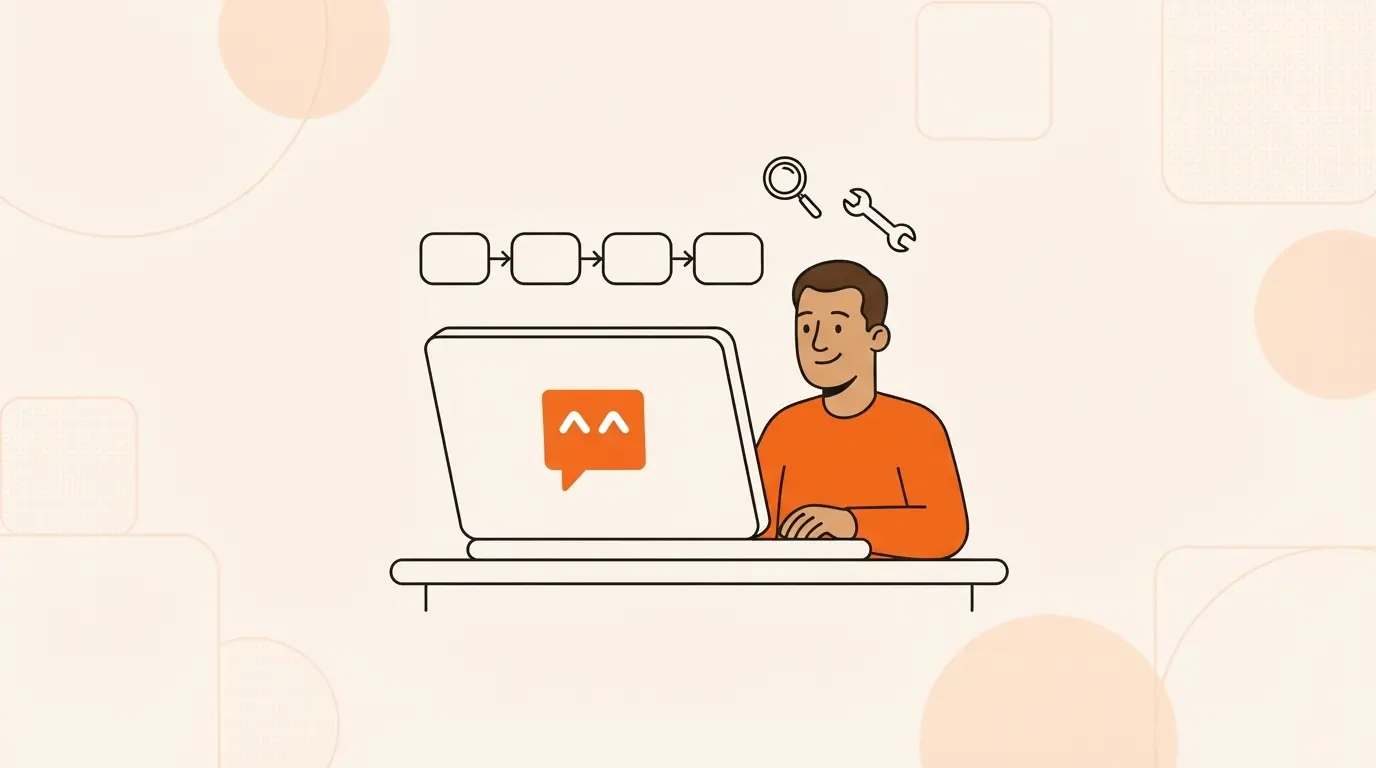
Four things move the price of a build:
- Each link to your CRM, calendar, email or accounting software adds work to build and test.
- A form that sends one email is simple. A workflow with custom code and rules for who gets which message, and when, takes longer.
- Duplicate contacts and missing fields need fixing before an automation can use them.
- Staff training and ongoing support add time after the build, so ask what each one includes.
We could not find a public survey that reports what Australian small businesses paid for builds. The National AI Centre tracks adoption and barriers instead. A written scope lets you compare two quotes like for like.
How Should a Build Be Priced and Quoted?
A fixed price sets the cost before work starts, and an hourly rate depends on how long the work takes. We quote a fixed price for each build through our AI automation service in Sydney, with no lock-in contract. Every build starts with a process audit, because the cost depends on your workflow.
A good quote puts these in writing:
- Which jobs the automation does, and which it leaves to your team.
- The tools it connects, such as your CRM, calendar, email and accounting software.
- Whose accounts hold the platform and AI model bills, and what those bills are likely to be each month.
- What training and ongoing support are included, and for how long.
- The price, whether it is fixed, and whether it includes GST.
Those platform and model bills are the running costs, and they follow different rules from the build fee.
What Does AI Automation Cost to Run Each Month?
Running costs are charged by use, so they rise and fall with your enquiry volume. The table assumes 1,000 enquiries a month. Each one uses about 2,000 tokens in and 500 tokens out, which is our assumption, not a vendor figure. A token is a small piece of text, roughly three-quarters of a word.
Prices were checked on 17 October 2026 and converted at the Reserve Bank of Australia rate of US$0.6947. Zapier states US dollars. Claude, Twilio, Vapi and Intercom show a $ sign without naming a currency, so we treated them as US dollars. Ex GST means before the 10% goods and services tax.
| Cost Item | Vendor Price | What It Means for You |
|---|---|---|
| Workflow platform, Zapier | From US$19.99 a month | About $29 a month |
| Workflow platform, Microsoft | $22.40 per user a month, billed yearly, ex GST | Priced per person, not per task |
| Small AI model, Claude API pricing | US0.10permilliontokensin,US0.50 per million out | About $0.65 for 1,000 enquiries |
| Mid-tier AI model, Claude API pricing | US2permilliontokensin,US10 per million out | About $13 for 1,000 enquiries |
| Text messages, Twilio | US0.0515permessagesegmentsent,US0.0075 per message received, US$8.25 a month for a mobile number | About $85 for 1,000 enquiries with one message each way, plus $12 a month for the number |
| AI voice agent, Vapi | US82toUS129 for 1,000 minutes, by the vendor's own estimate | About $118 to $186 for 1,000 minutes |
| Packaged chatbot, Intercom | From US$0.99 per outcome | About $1,425 for 1,000 outcomes |
The AI model is the smallest line, and texts and phone minutes cost more than the AI that writes them. A small model handles 1,000 enquiries for under a dollar, and a mid-tier model for about $13. If a vendor bills in US dollars, your invoice moves with the exchange rate.
How Much Does an AI Chatbot Cost in Australia?
An AI chatbot has a one-off build fee plus a monthly bill that depends on how you pay for the AI behind it. With a custom chatbot, you pay the model provider directly, and the bill follows your enquiry volume. A packaged product charges for each outcome it delivers, and the bill follows the number of outcomes.
Ask which of the two a quote assumes, and what counts as an outcome. Ask how the chatbot hands difficult enquiries to a person, too. In the National AI Centre survey, about 65% of businesses not using AI cited distrust of AI decisions or a preference for human control. Once you know both bills, you can test whether the automation pays for itself.
How Long Before AI Automation Pays for Itself?
AI automation pays back when your monthly saving beats the running cost plus the build fee spread over the months you use it. The process audit maps your current workflows and finds the tasks that waste time, and it gives you the hours to work with. For Made to Help we built an AI voice admin assistant called Alice that handles routine admin. The case study gives no hours saved, so the numbers below are assumed.
Say your team spends 1,000 minutes a month on routine calls, about 16.7 hours, and an hour of staff time costs $50. The task then costs about $833 a month. A voice agent at $118 to $186 a month leaves a saving of about $647 to $715. Divide the build fee by that saving to get the months to pay back.
The example assumes the agent takes every call, and it will not, because staff review time and handed-back calls shrink the saving. The National AI Centre found that roughly half of AI users check outputs before they affect customers, so count that time too. We found no independent Australian payback study for small businesses, so log your own calls for four weeks first. Privacy and consent rules add more time on top.
What Do Privacy and Regulator Rules Add to the Cost?
Privacy and consent rules add staff time to any automation that touches personal information. Which rules apply depends on who you are.
Privacy Policy Changes From 10 December 2026
From 10 December 2026, organisations covered by the Privacy Act must add new details to their privacy policy in some cases. The OAIC says it applies when a program uses personal information to make, or closely support, a decision that could significantly affect a person. A form that books a callback may fall outside those conditions, while a tool that decides who gets a service may fall inside them. The OAIC publishes a fact sheet and a flowchart to check yours.
Health Practitioners
Ahpra (Australian Health Practitioner Regulation Agency) says practitioners stay responsible for care whatever technology they use, and must apply human judgment to any AI output. Ahpra's guidance also says that for AI scribes, which record and write up consultations, this generally means getting informed consent from the patient. The guidance was last reviewed in August 2024, so check it for updates.
NDIS Providers
The NDIS Quality and Safeguards Commission (NDIS Commission) published a position statement in February 2026 on AI in behaviour support plans. It does not endorse any AI tool. It expects providers who use AI to de-identify all information, which means removing details that identify a person. It also expects them not to share any participant's personal information with AI systems.
Consent steps, de-identification and review time all take staff time, so add them to your running-cost budget. We do not give legal advice, so check the regulators' pages for your own situation. The next question is what you can claim back.
Can You Claim AI Automation Costs on Tax?
The ATO lets businesses deduct most software subscription fees in the year they incur them, for the business part of the use. The instant asset write-off is now $20,000, permanently, from 1 July 2026. Businesses with turnover under $10 million can deduct an eligible asset below that amount straight away.
The ATO says the measure is now law. Assets at or above $20,000 can go into the small business simplified depreciation pool. It writes off 15% in the first year and 30% in later years.
Whether a custom automation build counts as an asset, or as software with its own rules, is for your accountant to decide. Three smaller questions come up often, and the FAQ answers them.
FAQ
Can a team AI plan replace a custom build?
Only for individual tasks, because a team plan gives each person an assistant for drafting and research. Microsoft 365 Copilot Business costs $37.68 per user a month ex GST on Microsoft's monthly billing. Yearly billing costs $26.91 under an offer for existing Microsoft 365 Business customers that ends on 31 December 2026. Sending follow-ups and updating your CRM automatically still needs a workflow built around your tools.
Is there government funding for AI automation?
The federal AI Adopt Program paid for up to five advice centres, not for businesses to buy AI tools. The centres serve small and medium businesses in National Reconstruction Fund priority sectors, and the grant round is closed. State programs change, so check business.gov.au for yours.
Do I pay GST on AI software bought from overseas?
Not if you are registered for GST and the software is for your business. The ATO's GST guidance says a registered business shouldn't be charged GST on imported digital products. Give the supplier your ABN and say you are registered. If you are registered but can't claim a full GST credit, the reverse charge applies, and you pay the 10% GST to the ATO yourself.
Ready to Talk Through Your Numbers?
Book a strategy call and we will map your workflow and quote a fixed price.
Book a Strategy Call